

Overview
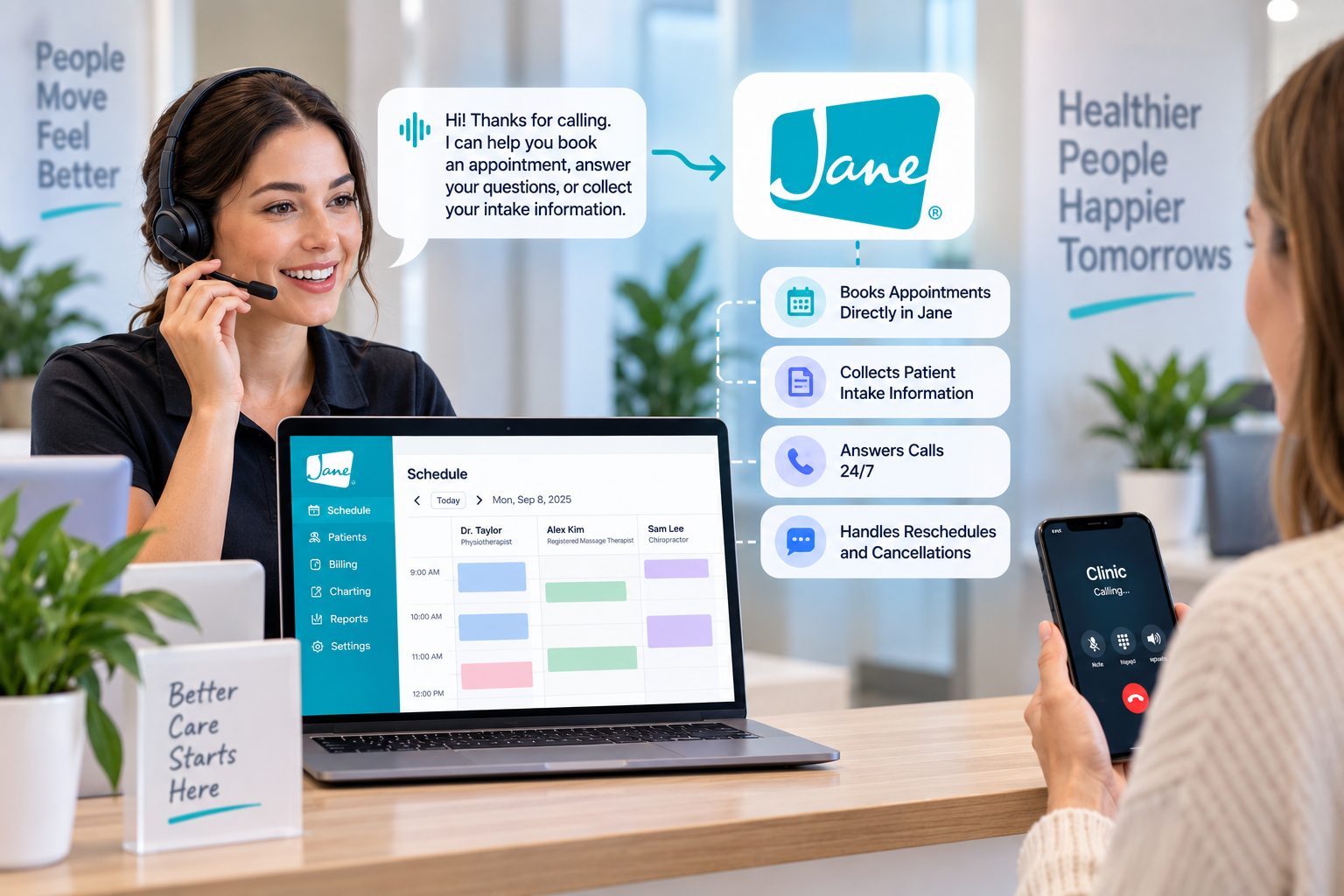
An AI receptionist can complement Jane App by handling the communication and administrative tasks that often overwhelm busy healthcare practices. While Jane App manages scheduling, charting, online booking, telehealth, billing, and reminders, an AI receptionist can answer calls, manage bookings and cancellations, collect patient intake information, handle after-hours inquiries, and support waitlist management. By integrating these functions with Jane App, clinics can reduce missed calls, streamline patient intake, minimize front-desk workload, and provide faster access to scheduling support without replacing their existing staff.
AI Receptionist for Jane App: Smarter Scheduling and Patient Intake
Four missed calls during one treatment block. Not a hypothetical Tuesday, a real one, at a busy physio clinic. The therapist has both hands on a patient's shoulder. Out front, the one person on desk is checking someone out while a walk-in stands there waiting to rebook. The phone rings through all of it.
Two of those four callers had booked somewhere else by dinner.
Nothing about that clinic was broken. The front desk was outnumbered, that's all. Jane App was already handling the calendar, the charting, online booking, telehealth, the billing side of things. Jane just doesn't pick up a ringing phone, and it won't chase anybody for intake paperwork. That's the gap an AI receptionist sits in.
What Jane App does (and what still lands on your front desk)
Jane App is practice management software, and physio clinics are only part of who runs on it. Chiropractors use it. So do massage therapists, mental health counselors, naturopaths, plenty of dentists. It keeps the schedule, stores SOAP notes, runs online booking and telehealth, takes payments. Solo or group, most practices find that side of things holds up fine.
Here's the rough split of who does what. Jane owns the appointment calendar, online self-booking, charting and SOAP notes, telehealth, billing and payment processing, plus the automated email and SMS reminders. All of that is handled.
Then there's everything else. Someone still has to answer the phone, and call back the people who got missed. Someone deals with the overflow on a Monday morning when three lines light up at once. New patients need intake forms filled in, insurance checked. Same-day cancellations come in by phone, and when they do, somebody has to work the waitlist fast enough to plug the hole before the slot goes empty. That second pile is what buries a front desk, and it does the most damage on the days you're already a person short.
How an AI receptionist actually works with Jane App
The simplest way to picture it is a second person on the desk, one who happens to work the phone, the text line and web chat at the same time. Someone calls wanting a new appointment. Or they need Thursday moved to Friday. Or they're cancelling, or they only want to know whether you're open Saturday. The AI takes that conversation.
What makes it useful for Jane users specifically is that it doesn't stop at taking a message. An AI receptionist that integrates with Jane App reads your live availability and books the appointment while the caller is still on the line. A reschedule or a cancellation works the same way. The change is sitting in Jane before they hang up.
Anything too complicated, or too sensitive for automation, gets routed through to your staff. Nobody ends up trapped in a phone tree.
What happens to calls after hours or during a rush?
Two quiet money leaks that most clinics never measure.
Start with the after-hours calls. Research on after-hours demand puts roughly a third of calls to medical practices outside normal office hours (Eastwood et al., BMJ Open, 2014). Separately, Pew found around 70% of people who land in voicemail hang up rather than leave a message (Pew Research Center, 2015). Those callers weren't telemarketers. They wanted an appointment and didn't get one. An AI receptionist picks up at 9pm on a Sunday and books the slot.
Then there's the morning rush. A human at your desk takes one call at a time, and that's the whole constraint. The AI runs several conversations at once, so the third and fourth caller in the 8am block actually get through instead of hitting a busy signal or ringing out.
Can it collect patient intake before the first visit?
Yes, and this is the part that saves the most time day to day. During the booking call the AI collects the things you'd otherwise chase on paper afterward. Reason for the visit, contact details, insurance, whatever consent forms you use. Depends how you've set it up. If something's easier to do on a screen, it texts the patient a secure link once the call ends.
So the patient walks in and half the chart is already populated. Nobody at your desk is typing up a handwritten form five minutes before the appointment starts. Check-in moves faster, and you lose the typos that come from deciphering someone's handwriting.
Some specialties get more out of this than others. therapy and mental health practices are the obvious case. First contact with a therapy patient is delicate, the intake questions are personal, and a no-showed 50-minute session is close to unfillable on short notice. Having the scheduling and the paperwork done before anyone walks in changes how the whole day runs.
Does it help with no-shows?
No-shows are a tax on every clinic. A systematic review of the literature put the average outpatient no-show rate at 23%, with some specialties running 30% and up (Dantas et al., BMC Health Services Research, 2018). Jane sends reminders and that helps. But a reminder only works on the patient who reads it and then does something about it.
An AI receptionist stacks a few things on top of that. Booking confirmations go out automatically. The "hey can I move my Tuesday appointment" text gets answered without anyone on your team putting down what they're holding. If an earlier slot opens up, it offers it. And when a cancellation comes through, it works the waitlist to fill the gap. Rescheduling by text takes maybe ten seconds, which is the difference between a reschedule that actually happens and a patient who just doesn't turn up.
Will patients know they're talking to AI? Does that hurt trust?
Usually they can tell, and for most people that's fine. What annoys a patient isn't the AI. It's getting stuck in a loop with no route to an actual person. An AI that's upfront about what it is, books quickly, then hands off the moment things get complicated doesn't bother anyone much. Meanwhile your staff has more attention left for the patient standing in front of them, which is the thing patients actually notice.
How does cost compare to other options?
Three common ways to cover the phone, all with trade-offs.
A full-time front desk hire gets you a real person. It also gets you salary and benefits, a training period, and an empty chair whenever they're on break or home sick. An answering service is cheaper, billed per call or per minute, but they take messages. They don't book. Your staff still keys everything into Jane the following morning.
An AI receptionist runs below the cost of a hire, doesn't take lunch, and writes bookings straight into Jane. Whether it's the right fit really comes down to call volume and hours, plus how much of the intake you'd rather have finished before patients arrive.
FAQ
Does an AI receptionist replace my front desk staff?
No. It picks up the repetitive phone work: the routine booking calls, the intake collection, the after-hours stretch, the fourth caller in a row on a Monday. Your team stops getting pulled away from the patient in the room every few minutes. Nobody gets replaced. Most clinics run it for overflow and off-hours.
Does it book directly into Jane App?
It does. Live availability comes out of Jane, the booking goes back in, and reschedules and cancellations sync the same way.
What happens if the AI can't handle a call?
It transfers to a staff member, or takes a message if nobody's free. Anything complicated or sensitive goes straight to a human.
Can it handle reschedules and cancellations, not just new bookings?
Yes, same process. The change is in Jane immediately.
Does it work for a solo practitioner as well as a larger clinic?
Solo practitioners probably get the most out of it, honestly. Work alone as a chiropractor or a massage therapist and there's simply nobody free to answer the phone while your hands are on a patient. The AI picks up instead.
What channels does it cover?
Phone, text and web chat, in most setups. Any of the three can end in a booking inside Jane.
Is patient information handled carefully?
In the U.S., any vendor that touches protected health information has to be HIPAA-compliant, and they should be signing a Business Associate Agreement with your practice before anything goes live. The BAA is the document that legally holds them to the same standards you're already held to.
Jane App is Canadian, and a good share of its users practice there, so PIPEDA is often the relevant framework instead. It governs how personal health information gets collected and used. Country aside, a few things are worth confirming with any provider: that data is encrypted in transit and at rest, that there's a written retention policy, that an audit trail exists and you can actually pull it. Sort the BAA or its equivalent out before launch, not after.
Conclusion
Back to the physio clinic with the phone going during a treatment. Jane App wasn't the problem there. It was doing exactly what it's built to do. The problem was the phone, and the new-patient paperwork stacking up next to it. That's the gap an AI receptionist covers. Jane keeps the practice running; the AI catches what used to fall through while everyone was busy.
References
Dantas, L.F., Fleck, J.L., Cyrino Oliveira, F.L., Hamacher, S. (2018). No-shows in appointment scheduling: a systematic literature review. BMC Health Services Research, 18(1), 564.
Eastwood, K., Morgans, A., Smith, K. (2014). Characteristics of demand for after-hours primary medical care in Australia and the United States. BMJ Open, 4(1), e003580.
Pew Research Center (2015). Americans' views on mobile etiquette: voicemail and phone behavior trends.


