

Overview
HIPAA-compliant AI receptionists help healthcare practices automate calls, scheduling, and patient communication. The key factors are BAA coverage, security documentation, pricing, and the level of EHR integration offered.
Best HIPAA-Compliant AI Receptionist in 2026: Verified BAA, Pricing and EHR Matrix
Last checked: September 2026. Every compliance and pricing claim below was read directly from the vendor's own published pages on that date. No executed BAAs, private SOC 2 reports, or live patient calls were reviewed.
The short answer. There is no single best HIPAA-compliant AI receptionist, because the category splits by how deep into your systems the AI has to reach. For small and mid-size practices that need calls answered and appointments booked on a connected calendar, Central is the value pick: it publishes HIPAA compliance, executes BAAs, holds ISO 27001:2022 certification, and is the only vendor here below $100 a month with all three published. For specialty and multi-location groups that need bookings written into the chart during the call, Assort Health is the pick. For health systems standardised on Epic, Hyro. For athenahealth, ModMed, or Elation practices, Talkie.ai. For practices already on RingCentral, RingCentral AI Receptionist.
The vendor with the best compliance paperwork and the vendor with the best clinical workflow are usually not the same. This guide scores those two things separately.
Key Takeaway
What counts as a HIPAA-compliant AI receptionist?
Bottom line: One that will sign a Business Associate Agreement that covers the specific service tier you are buying these things, documents the HIPAA Security Rule safeguards it applies, and tells you where call recordings and transcripts live there.
An AI receptionist becomes a business associate the moment it creates, receives, maintains, or transmits protected health information on your behalf in any way. A voice recording of a patient giving a date of birth and an appointment reason is PHI. So is the transcript, the summary, and often the call metadata.
The vendor's marketing page is not the artifact that matters. The BAA is. Six things belong in your screening filter before you book a single demo:
- A signed BAA covering the exact SKU you are paying for, not the parent company and not an enterprise upgrade path.
- Documented encryption for ePHI in transit and at rest.
- Role-based access controls and exportable audit logs.
- A breach notification process with a contractual timeline.
- Configurable retention and destruction for recordings and transcripts.
- A disclosed subprocessor chain, since most voice AI runs on third-party speech and language models.
Review the published evidence, confirm BAA scope for your SKU, then approve the PHI workflow. A published statement starts the review. It does not replace a signed agreement.
HIPAA, BAA, and pricing matrix
Bottom line: Four vendors publish HIPAA and BAA language you can read before a sales call. Two publish pricing. The rest require a quote.
Vendor | Published HIPAA and BAA evidence | Published pricing | EHR or calendar depth |
| Central | Trust and security page states full HIPAA compliance, BAAs executed with all customers handling PHI, ISO 27001:2022 certified | $89/mo for 90 calls, 10-day free trial | Calendar booking (Cal.com, Calendly, Google Calendar); CRM via Zapier |
| Assort Health | States HIPAA compliance, SOC 2 Type II certification, and a signed BAA with every client; SOC 2 report and security questionnaire on request | Quote only | Bidirectional write-back; names Epic, Oracle Health, athenahealth, NextGen, eClinicalWorks, ModMed, Allscripts, Veradigm |
| Hyro | Provider and Epic integration pages describe HIPAA-compliant agents; certified in Epic's Vendor Services marketplace | Quote only | Epic-native; pulls records, books, reschedules, cancels, feeds pre-defined Epic scheduling modifiers |
| Talkie.ai | Security materials state HIPAA compliance and SOC 2 Type II certification | Quote only | Native read/write with athenahealth, ModMed EMA, Elation Health, AdvancedMD, eMedicalPractice |
| RingCentral AI Receptionist | Announced with HIPAA-supporting security and privacy controls; BAA requested per account | From $39 per license including 100 minutes | Appointment booking and CRM sync; no EHR write-back claimed |
| Keona CareDesk | Integrations page documents HIPAA-compliant text, secure messaging and fax | Quote only | Delivered integrations with Epic, Cerner, Allscripts, Athena, and Greenway plus 50+ other EHRs; depth varies by connector |
| Smith.ai | Healthcare materials state it is not HIPAA compliant and cannot handle PHI | From $95/mo (AI tier) | Not applicable for PHI workflows |
Documentation readiness versus workflow depth
Bottom line: Scoring these on one number hides the trade-off. A vendor can have excellent paperwork and a shallow product, or the reverse.
Two separate editorial scores, both based on public documentation only, neither based on hands-on call testing.
Documentation readiness weights: BAA and HIPAA statement clarity 40%, pricing transparency 25%, security certifications 20%, retention and subprocessor disclosure 15%.
Workflow depth weights: EHR or calendar write depth 40%, scheduling and rescheduling completeness 25%, escalation and human handoff 20%, language coverage 15%.
Vendor | Documentation readiness | Workflow depth |
| Central | 88 | 62 |
| Assort Health | 85 | 94 |
| Talkie.ai | 78 | 86 |
| Hyro | 76 | 91 |
| RingCentral AI Receptionist | 72 | 58 |
| Keona CareDesk | 68 | 79 |
| Smith.ai | Disqualified for PHI | Not scored |
Central tops documentation readiness because it is the only vendor publishing a HIPAA statement, BAA commitment, ISO certification, and a real price without a sales conversation. It sits mid-table on workflow depth because it books to calendars, not charts. Assort Health leads workflow depth and sits a fraction behind on documentation only because its pricing is quote-gated.
Central
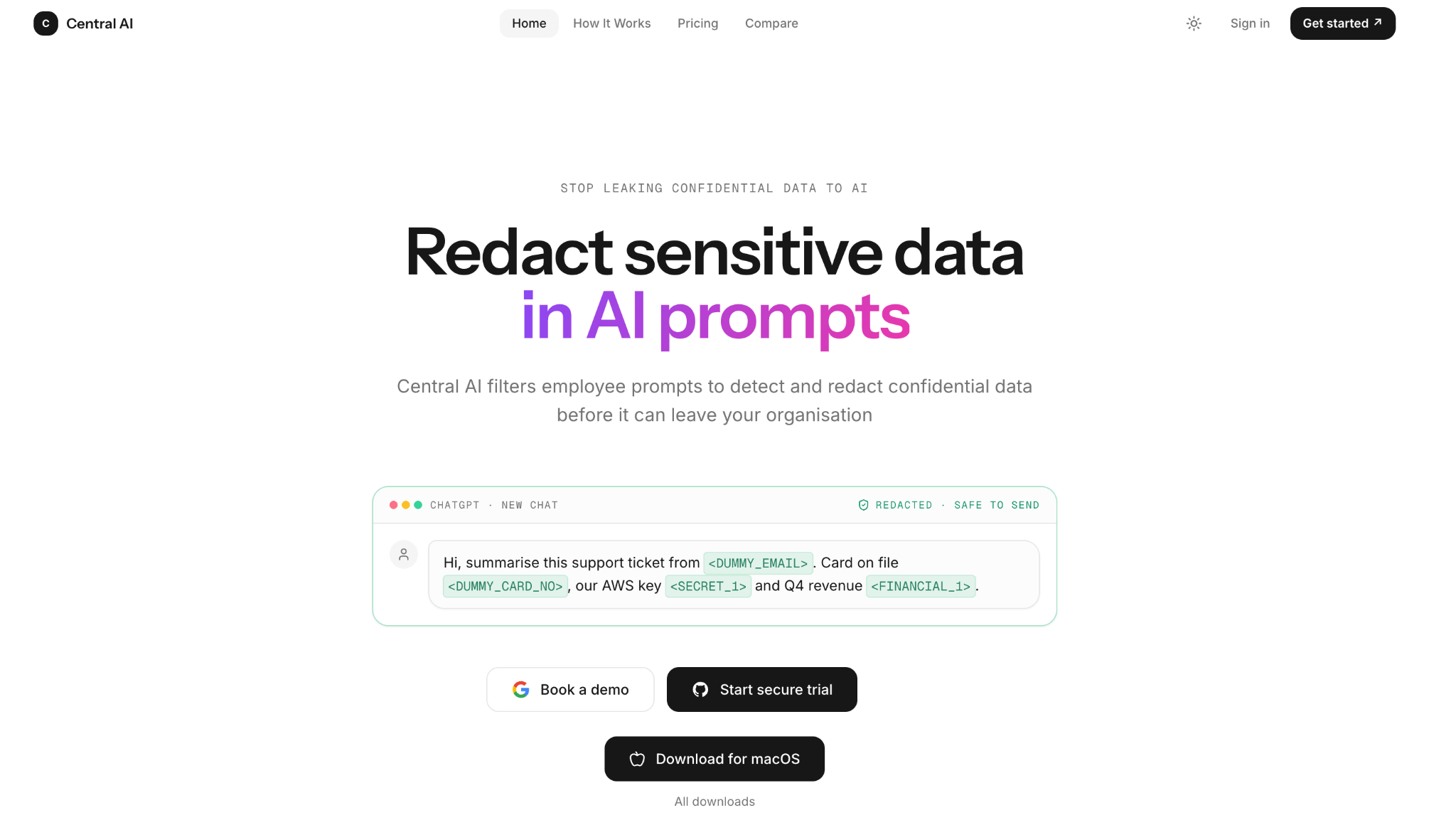
Best for small and mid-size practices that want published compliance terms at a published price.
Central is the value pick for practices that need reliable answering and calendar booking with compliance documentation they can read up front.
Central pros
- Answers calls 24/7 and books into a connected calendar during the call, with SMS booking links as a fallback.
- States full HIPAA compliance, executes BAAs with all customers handling PHI, and is ISO 27001:2022 certified is well.
- Trains on your website and uploaded documents, so routine FAQ handling is live without script writing.
- Supports more than 30 languages and connects to a CRM through Zapier that’s a good thing, with a free built-in CRM included.
Central cons
- Calendar-first scheduling. No EHR write-back is advertised.
- Compliance terms sit on the trust and security page rather than the product page, so scope needs confirming.
- Live receptionist escalation is a paid add-on and connects only when a receptionist is available.
My experience with Central
The booking workflow is the strongest part: offer available times, confirm the caller's choice, write the appointment to the connected calendar, and text a link when the caller wants to finish later. Training from a URL and uploaded documents means a clinic can be answering hours, location, and policy questions within a day rather than building out a contact-center stack. Practices that start out pricing healthcare call center solutions frequently discover the reception layer alone absorbs the overflow, and Central is built squarely for that layer rather than for queue and agent management.
Keep the evaluation honest about the ceiling. This is the right tool when appointments can live on a calendar and staff move them into the chart afterwards. If bookings must land in Epic before the patient hangs up, look at Assort, Hyro or Talkie instead. Confirm the BAA covers recording, transcription, and storage before routing live patient calls.
Central pricing
Published at $89 per month for 90 calls with a 10-day free trial, covering the AI receptionist rather than live receptionist staffing. Budget separately for the human-support add-on.
Assort Health
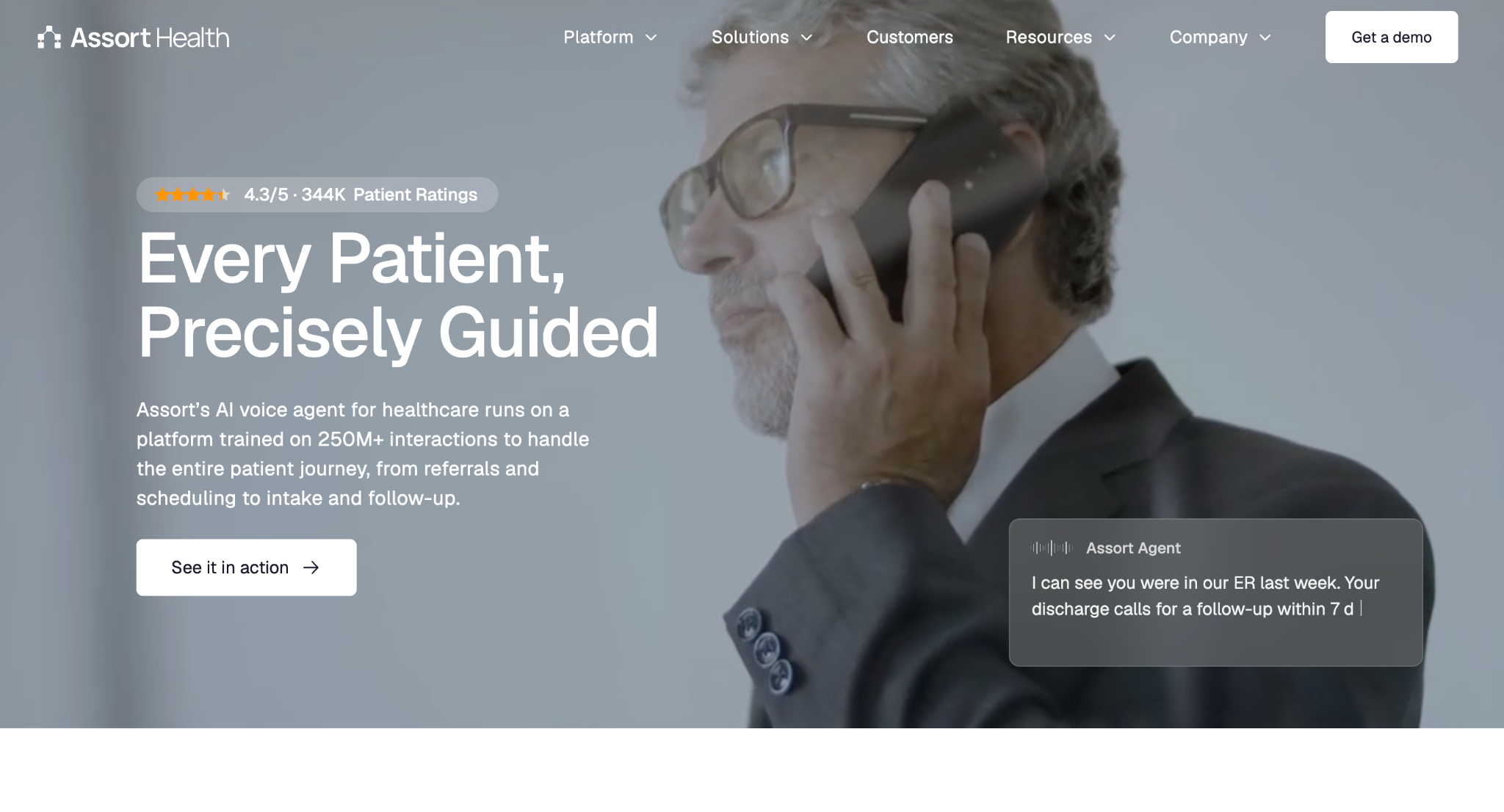
Best for specialty and multi-location groups that need bookings in the chart.
Assort Health is the pick when bookings have to land in the EHR, and your scheduling rules are too specific for a generic receptionist.
Assort Health pros
- States HIPAA compliance, SOC 2 Type II certification, and a signed BAA with every client.
- Bidirectional EHR write-back naming Epic, Oracle Health, athenahealth, NextGen, eClinicalWorks, ModMed, Allscripts, and Veradigm.
- Specialty-specific scheduling logic across more than 20 specialties, covering triage, intake, refills, and referrals.
- Provides a completed security questionnaire, SOC 2 report, and signed BAA on request.
Assort Health cons
- Quote-only pricing with no self-serve trial.
- Sales-led implementation, so time to value is measured in weeks.
- Built for specialty and multi-location groups, which makes it heavy for a solo practice.
My experience with Assort Health
What separates Assort from most of this list is that it treats a booking as complete only when it exists in the EHR, and it says so explicitly in its own integration guidance. That is the right standard, and it is also the right demo test: book a test appointment on a live call and watch whether it appears on the resource schedule with the correct provider, visit type, and duration.
The specialty protocol depth is real but needs matching to your own rules rather than being accepted at the category level. Ask which of your visit types are pre-built and which require configuration, and get the subprocessor list alongside the BAA.
Assort Health pricing
Quote only, with no published rates. Ask for implementation and connector costs alongside the recurring figure.
Hyro
Best for health systems running patient access at Epic scale.
Hyro is the enterprise entry point for large patient-access teams.
Hyro pros
- Provider and Epic pages describe HIPAA-compliant AI agents built for healthcare.
- Certified in Epic's Vendor Services marketplace, with agents that pull records from Epic to verify patients.
- Books, reschedules, and cancels around the clock and feeds pre-defined Epic scheduling modifiers that update automatically.
- Stated as in use by 45+ health systems, with voice, web, SMS, and mobile coverage.
Hyro cons
- Enterprise procurement and custom scoping only.
- Quote-based pricing with no published rates.
- Little relevance to single-provider clinics without Epic.
My experience with Hyro
The scheduling-modifier handling is the detail worth demoing hard. Most vendors can offer a slot. Far fewer can apply a health system's own modifier logic and stay current when those rules change. For an Epic organisation, that is the difference between automation and a queue of requests staff has to finish.
Ask for the BAA and security package early rather than at the end. Marketplace certification covers the integration, not every AI service you might buy alongside it.
Hyro pricing
Quote only, enterprise procurement. Request a scoped healthcare quote with implementation included.
Talkie.ai
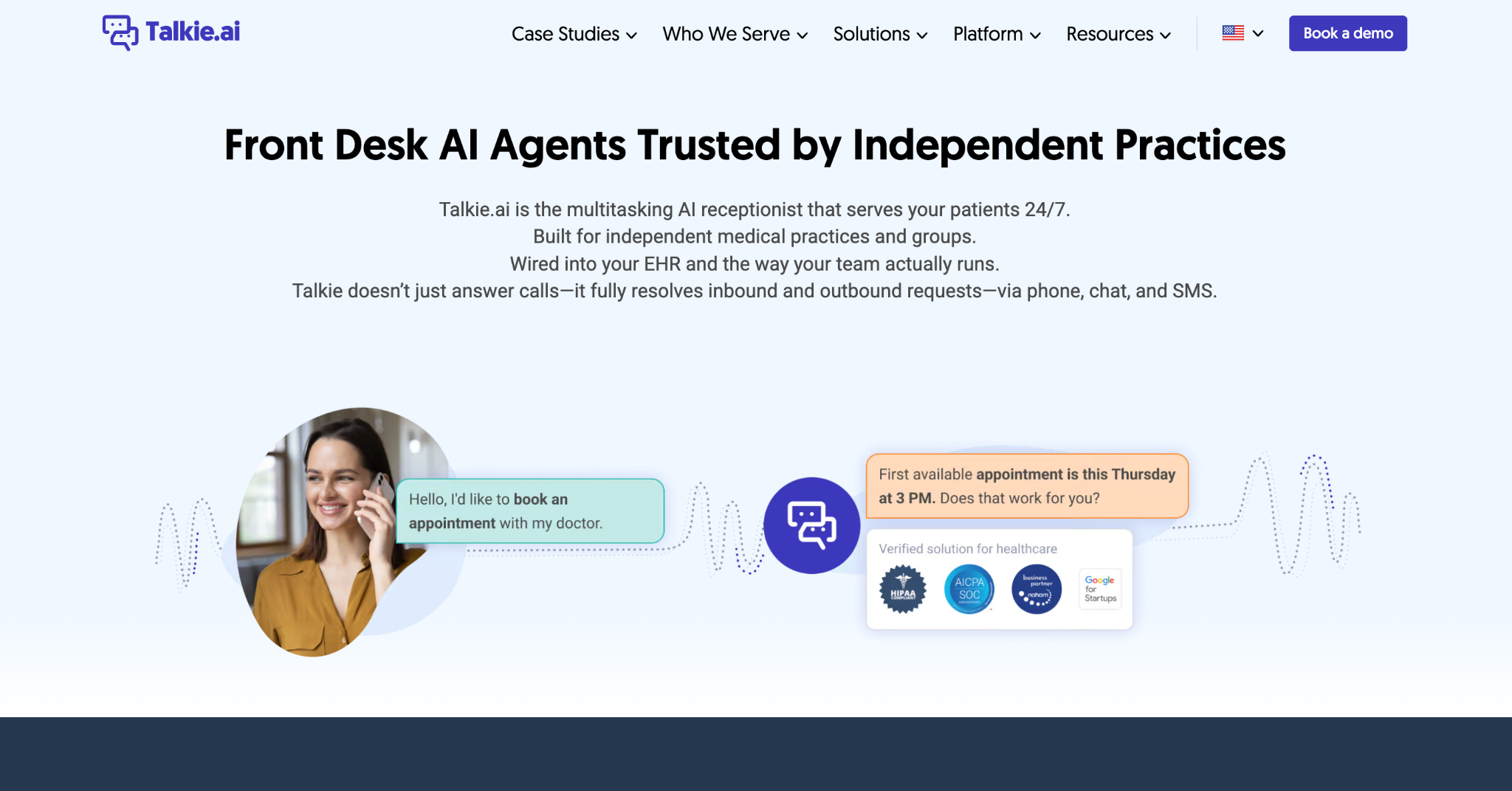
Best for practices running athenahealth, ModMed, or Elation.
Talkie.ai is the fit when calendar-only booking will not do, and your EHR is one it connects to natively.
Talkie.ai pros
- States HIPAA compliance and SOC 2 Type II certification in its security materials.
- Native read/write integrations with athenahealth, ModMed EMA, Elation Health, AdvancedMD, and eMedicalPractice, with interactions logged in the EHR in real time.
- Handles scheduling, rescheduling, prescription refill requests, new-patient intake, and chart creation.
- Multilingual coverage with two-way texting, and agents that identify themselves as AI.
Talkie.ai cons
- Quote-only pricing with no free trial.
- Epic and Cerner are absent from its native integration list.
- Healthcare-only scope, so it covers no general business calling.
My experience with Talkie.ai
The EHR claim here is more specific than most, which is a point in its favour. It names the systems and describes writing appointments, refills, and cases into them during the call rather than after. The value therefore depends almost entirely on whether your EHR is on that list.
Scope refill handling carefully. It collects and routes requests; it is not making clinical decisions, and the demo should confirm the agent refuses to drift in that direction.
Talkie.ai pricing
Quote only. Request a figure tied to your specific EHR connector and call workflows.
RingCentral AI Receptionist
Best for practices already on the RingCentral phone stack.
RingCentral AI Receptionist is the path of least resistance when the phone system is already in place.
RingCentral AI Receptionist pros
- Published at a transparent per-license price with included minutes, unusual in this category.
- Announced with encryption, access controls, and audit logging positioned to support HIPAA requirements.
- Handles answering, routing, FAQs, appointment booking, SMS follow-up, and multi-location setups.
- Call analytics surface the questions causing transfers so answers can be corrected.
RingCentral AI Receptionist cons
- BAA coverage has to be confirmed for your specific account and SKU rather than assumed.
- No EHR write-back; deeper scheduling needs configuration.
- Per-minute overage past the included allowance, and published prices differ across RingCentral's own bundled and standalone listings.
My experience with RingCentral AI Receptionist
This is a phone-system layer with AI on top rather than a healthcare workflow engine, and it is the right answer mainly when the phone system is already in place. The economics work at low call volume and degrade as minutes climb.
Because the pricing appears differently across bundled and standalone listings, get the all-in figure for your account in writing, including overage, before comparing it to anything else here.
RingCentral AI Receptionist pricing
Published from $39 per license including 100 minutes of use, with additional minutes in bundles. Confirm your account's actual rate and overage in-platform.
Keona CareDesk
Best for patient-access teams managing more than the phone.
Keona CareDesk suits organisations whose problem is broader than answering calls.
Keona CareDesk pros
- Documents HIPAA-compliant text, secure messaging and fax in one interface.
- Delivered integrations with Epic, Cerner, Allscripts, Athena and Greenway, plus 50+ other EHRs.
- Combines caller screen-pop, queues, and rules-based scheduling for staff-side workflow.
- Single sign-on through the EHR, the phone system, or Active Directory.
Keona CareDesk cons
- Quote-only pricing and sales-led procurement.
- Implementation requires staff training and workflow change, not just configuration.
- Its own materials note integration depth varies and read-only pulls are common.
My experience with Keona CareDesk
This is an operational platform rather than a lightweight receptionist, and it should be evaluated as one. Screen-pop, queues, and scheduling rules address the staff side of patient access, which is a different problem from missed calls.
The integration list is broad, but breadth is not depth. Ask which appointment fields and actions your specific connector supports before treating it as write-back.
Keona CareDesk pricing
Quote only. Ask for implementation and connector costs separately from the recurring licence.
Smith.ai
Included as a disqualification, not a recommendation.
Smith.ai is here for the opposite reason to everything above: to rule it out of PHI workflows.
Smith.ai pros
- Long-established virtual receptionist service with AI and live-agent tiers.
- Published entry pricing, unusual in this category.
- Broad integration ecosystem across CRMs, calendars, and practice management tools.
- Appropriate for veterinary, wellness and other healthcare-adjacent businesses.
Smith.ai cons
- Its own healthcare materials state it is not HIPAA compliant and cannot handle PHI in regulated environments.
- That rules it out of medical, dental, and behavioural health call handling entirely.
- Patient scheduling alone can constitute PHI, so partial use is not a safe workaround.
My experience with Smith.ai
The useful thing about Smith.ai in this comparison is the clarity. Most vendors in adjacent categories leave their HIPAA position ambiguous, and buyers have to infer it. Smith.ai states the limitation plainly, which is more helpful than a vague compliance page.
If a vet clinic, wellness centre, or coaching practice is the use case, it belongs on the shortlist. If a date of birth and a reason for visit will be spoken on the call, it does not.
Smith.ai pricing
Published AI receptionist pricing starts around $95 per month. Confirm current tiers directly, and treat pricing as irrelevant if PHI is in scope.
The integration depth ladder
Bottom line: Most "EHR integration" claims sit at level one or two. Ask which level you are actually buying.
Level | What happens | What it means for you |
| 1 | AI takes a message, sends a summary to staff | Safest starting point, lowest automation |
| 2 | AI texts the caller a booking link | Low risk, lower completion |
| 3 | AI books into a connected calendar | Real automation; staff still reconcile with the chart |
| 4 | AI reads availability and writes the appointment into the EHR | Highest workflow value, deepest BAA scrutiny |
| 5 | Scheduling plus referrals, refills, eligibility and routing | Highest value, highest review burden |
Central and RingCentral sit at level three. Talkie.ai, Hyro and Assort Health operate at four and five within the systems they name, and Keona varies by connector. One caveat sits underneath all of this: depth depends on the record as much as the connector. AI-ready EHRs holding structured, standardised data give a voice agent something dependable to read and write, while fragmented or unstructured records limit what any integration can safely automate, no matter which level the vendor claims.
Conclusion
Match the vendor to the depth your calls actually need. If appointments can live on a calendar and staff reconciles them into the chart, the reception layer alone solves the problem, and Central offers it with published compliance documentation at the lowest published price in this comparison. If bookings must land in the EHR during the call, Assort Health, Hyro, and Talkie.ai are the serious options, each strongest within the systems it names.
Whichever you pick, the sequence is the same. Read the published evidence, confirm the BAA covers your exact SKU and every artifact the call produces, demonstrate the scheduling action against your own system, and test escalation with synthetic details before a real patient ever reaches the AI.
FAQ
Are AI receptionists HIPAA compliant?
Some can be deployed in HIPAA-covered workflows when the vendor signs a BAA for the specific service tier and applies the Security Rule safeguards. There is no HIPAA certification for software. A vendor either signs a BAA covering your workflow or it does not.
Which AI receptionists publish HIPAA and BAA language openly?
Central, Assort Health, Hyro, and Talkie.ai all publish HIPAA statements on their own sites. Central and Assort Health both state that BAAs are executed with customers handling PHI. RingCentral positions AI Receptionist as supporting HIPAA requirements with the BAA requested per account.
What is the cheapest HIPAA-compliant AI receptionist?
Among vendors publishing both a price and a HIPAA statement, Central is the lowest at $89 per month for 90 calls. RingCentral AI Receptionist starts lower at $39 per license, but includes only 100 minutes and requires per-account BAA confirmation. Cheapest is not the same as safest.
Is Smith.ai HIPAA compliant?
No. Its own healthcare materials state it is not HIPAA compliant and cannot handle protected health information in regulated environments. It is positioned for veterinary, wellness, and healthcare-adjacent businesses.


